
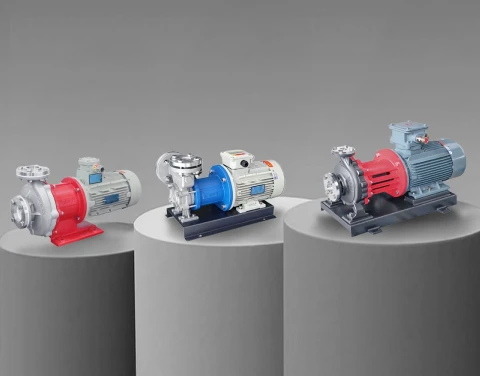





Dosing looks like a solved problem until the process downstream starts reacting to it. A metered chemical has to arrive in the right quantity, repeatably, often as a steady stream rather than a series of slugs, and frequently without a single drop escaping to the floor. The pump most plants reach for first — a reciprocating diaphragm or plunger metering pump — meters a fixed volume per stroke, which makes its discharge naturally intermittent. For many duties that pulsation is fine. For others it is the source of the very problem the dosing system was meant to solve. This page covers how Aulank's magnetic gear pumps deliver precise, pulsation-free, leak-free dosing, and is honest about where a reciprocating metering pump is still the right tool.
Why Precise Dosing Is Harder Than It Looks
Most metering pumps are positive-displacement pumps that move a defined volume on each stroke, which is what makes them meterable. The same mechanism creates the problems below:
● Pulsation. A reciprocating pump pushes liquid on the discharge stroke and pauses on the suction stroke, so flow is intermittent. Downstream, that pulsation reduces dosing repeatability, shortens valve and diaphragm life, and produces noisy flowmeter signals that push operators to overcorrect.
● Back-pressure losses. Lower-accuracy pump types eject less liquid as discharge pressure rises — some of the trapped volume simply is not pushed out, which is the opposite of what a metering duty needs. Holding volumetric output against changing back-pressure is exactly where accuracy is won or lost.
● Leakage on hazardous chemistry. Dosing fluids are often corrosive, toxic, or valuable, and a sealed pump puts a dynamic seal or a flexing diaphragm directly in contact with them — both are wear parts and both are leak paths.
● Turndown and linearity. A dosing pump has to hold its accuracy across a range of flows, not just at one set point, so output should track the control signal in a predictable, linear way.
● Shear and viscosity. Some dosed fluids are viscous or shear-sensitive, and a pump that handles thin reagents may stall on a thick binder or degrade a polymer.
The Aulank Approach: Pulsation-Free, Leak-Free Volumetric Dosing
Aulank approaches dosing with the magnetic gear pump, a sealless rotary positive-displacement pump. The gear mesh forms sealed chambers that carry a fixed volume per revolution, and a hermetic magnetic coupling drives the rotor through a containment shell. That combination changes the dosing picture:
● Near-pulseless flow. A gear pump delivers fluid without the surging pulses of a piston pump and with lower pulsation than a diaphragm pump, so it produces a smooth stream that needs no pulsation dampener and gives a clean, readable flowmeter signal.
● Excellent volumetric accuracy. Among dosing pump types, accuracy runs low for diaphragm, better for peristaltic, good for rotary-lobe, excellent for gear, and best for piston pumps. The gear pump sits near the top of that order and holds its output well against changing back-pressure.
● Zero leakage. Fitting the gear pump with a sealless magnetic coupling removes the dynamic seal entirely, so corrosive, toxic, or valuable dosing fluids stay hermetically contained — the same principle behind our leak-proof pump solutions.
● Viscosity-tolerant, low-shear delivery. Because output is set by displacement rather than velocity, a gear pump holds its metered volume as viscosity rises and handles thick or shear-sensitive media gently, which is why it also suits the duties on our high-viscosity pump solutions page.
The honest boundary matters here. A gear pump relies on close running clearances, so it needs a clean, non-abrasive fluid — abrasive solids wear the gears and clearances and erode accuracy over time. And for very-low-volume injection against high back-pressure, or stroke-by-stroke micro-dosing where each pulse is counted, a reciprocating diaphragm or plunger metering pump remains the standard tool, and that is not part of Aulank's range. Where the duty calls for smooth, accurate, leak-free metered transfer of a clean fluid, the magnetic gear pump is the stronger answer.
Pump Types and Working Principles
MDC-M Micro Magnetic Gear Pump (small-volume precise dosing)
The MDC-M micro magnetic gear pump is built for small metered volumes — reagent, additive, and sample dosing where the quantity is low but the accuracy and repeatability requirements are high. It delivers a smooth, pulsation-free micro-flow with zero leakage, suited to bench, skid, and OEM-integrated dosing.
MDC-K Magnetic Gear Pump (continuous and inline dosing)
The MDC-K magnetic gear pump covers the broad middle of dosing and metered-transfer duties: continuous ratio dosing, inline blending, and steady metered feed of clean process chemicals. It holds volumetric output across a wide viscosity range and runs sealless, and it is the same pump family used for precise transfer in demanding thermal and chemical service.
MDC-X Medium-to-Large Magnetic Gear Pump (higher-flow metered transfer)
For larger metered volumes — higher-flow dosing and metered transfer where smooth, leak-free volumetric delivery still matters — the MDC-X medium-to-large magnetic gear pump extends the same gear principle to bigger duties. The full Positive Displacement Pump Series covers the range, and the types of positive displacement pumps guide sets gear pumps in context against other positive-displacement types.
Where Pulsation-Free Dosing Solves a Real Problem
Smooth, leak-free metering earns its keep wherever the dosing point cannot tolerate pulsation or leakage:
● Additive and binder dosing. Metering additives, binders, and catalysts into coating, battery-electrode, and chemical processes, where a steady stream keeps the ratio and the product quality stable.
● Inline ratio blending. Dosing one stream into another at a fixed ratio — colour, fragrance, or reagent into a carrier — where pulsation would show up as streaks or off-ratio product.
● Lubricant and oil metering. Precise, repeatable delivery of oils and lubricants, where the fluid is viscous and the volume has to be exact.
● Reagent and chemical feed. Continuous feed of clean process chemicals where leakage of a corrosive or valuable reagent is unacceptable and a smooth flow aids control.
● Polymer and shear-sensitive dosing. Gentle metered delivery of polymers and other shear-sensitive fluids that a high-shear pump would degrade.
Matching the Pump to the Dosing Duty
As a starting point, the duty points to the pump — including the honest case where the answer is a reciprocating metering pump:
| Dosing duty | Fluid | Key requirement | Recommended pump |
| Micro-volume additive or reagent dosing | Clean chemicals, additives | Small-volume accuracy, pulsation-free, leak-free | MDC-M micro magnetic gear |
| Continuous ratio or inline dosing | Clean process chemicals | Smooth volumetric output, leak-free | MDC-K magnetic gear |
| Higher-flow metered transfer | Clean fluids and oils | Volumetric, pulsation-free, leak-free | MDC-X magnetic gear |
| Viscous metered dosing | Oils, resins, binders (clean) | Output held across viscosity, low shear | MDC-K / MDC-X magnetic gear |
| Very-low-flow injection against high pressure | Various | Stroke micro-dose against high back-pressure | Reciprocating metering pump (outside Aulank range) |
For clean fluids that need smooth, accurate, leak-free metering, the magnetic gear pumps cover the duty. The magnetic gear pump vs magnetic vortex pump comparison guide helps if you are weighing a gear pump against a vortex pump for a borderline case.
Key Selection Considerations
When you specify a dosing pump, the parameters that decide accuracy and reliability are:
● Flow range and turndown. The metered volume per unit time, and the range over which the pump must stay accurate, not just the single set point.
● Required accuracy and repeatability. How tightly the dose must be held, which sets where the duty falls on the accuracy order from diaphragm to piston.
● Back-pressure. The discharge pressure the pump doses against, since holding volumetric output against it is central to dosing accuracy.
● Fluid cleanliness. Whether the fluid is free of abrasive solids — a gear pump needs a clean, non-abrasive medium to protect its clearances and hold accuracy.
● Viscosity range. The viscosity at the dosing temperature, and how far it swings, which a positive-displacement pump handles far better than a centrifugal one.
● Leakage and materials. Whether zero leakage is required — it usually is for dosing chemistry — and which wetted materials suit the fluid. Aulank's dosing pumps sit within the Chemical Pump Series for material options.
● Control. How the dose is set and varied, whether by fixed speed or a variable-speed drive that trims output to a control signal.
Get a Dosing Pump Configuration for Your Process
Tell us the fluid, the dose rate and turndown, the back-pressure, the viscosity, and the leakage and material requirements, and our engineering team will configure a sealless magnetic gear pump for the duty — or tell you plainly if a reciprocating metering pump is the better fit for your case. Background on the working principle is in our positive displacement pump working principle and selection guide.
Talk to our team: Contact Aulank | WhatsApp: +86 13773157367 | Email: info@aulankpump.com
Related reading: positive displacement pump working principle and selection guide · high-viscosity pump solutions