



Acetone, methyl ethyl ketone and toluene are the workhorse solvents of coating lines, printing plants, adhesive production and pharmaceutical synthesis, and they share a combination of properties that punishes poorly specified pumps. Each fluid is thin enough to starve bearings of lubrication, volatile enough to flash inside a warm pump casing, and flammable enough that a single leaking seal constitutes a site safety event. Plants that transfer these solvents with general-purpose water pumps typically cycle through seal replacements every few months and carry an open leak path on a flammable service the entire time. This guide sets out the fluid properties that drive pump selection for solvent duty, the material and containment choices that follow from them, and the sealless magnetic drive configurations that production engineering teams standardize on for this service class.
Fluid Profile: What Makes Solvents Difficult to Pump
| Property (20 °C) | Acetone | MEK | Toluene |
|---|---|---|---|
| Specific gravity | 0.79 | 0.80 | 0.87 |
| Viscosity | 0.31 cP | 0.41 cP | 0.56 cP |
| Vapor pressure | 24.7 kPa | 12.1 kPa | 2.9 kPa |
| Boiling point | 56 °C | 80 °C | 111 °C |
| Flash point | -20 °C | -9 °C | 4 °C |
Three rows of this table carry most of the engineering consequence. Viscosity below one centipoise means the fluid forms almost no hydrodynamic film, so product-lubricated bearings and seal faces run with minimal lubrication and wear fast when dry. Vapor pressure in the tens of kilopascals means the fluid approaches boiling at ordinary suction conditions; a warm day, a long suction line or a low tank level is enough to push the pump into cavitation or vapor locking. Flash points at or below ambient temperature place every handling point inside a classified hazardous zone, where any atmospheric leak path from the pump is both a fire load and an emissions compliance issue. Pump selection for solvent service starts from these three constraints, and hardware choices follow from them directly.
Material Compatibility and Bearing Selection
Chemical compatibility is the one dimension where solvents are forgiving: 316L stainless steel handles acetone, MEK and toluene without corrosion concerns, and PTFE or PFA linings are equally inert to all three. The materials that fail on solvent duty are elastomers and bearing systems, not metals. Standard NBR and EPDM gaskets swell in ketones and aromatics, so wetted seals, where any exist, must be PTFE or FFKM. For bearings, the poor lubricity of thin solvents rules out carbon graphite grades that depend on fluid film support; pressureless-sintered silicon carbide is the standard choice because its hardness and chemical inertness tolerate intermittent starved lubrication during priming, tank-empty events and process upsets. Magnetic coupling magnets see no compatibility issue at solvent temperatures, since standard neodymium assemblies hold full torque well above the boiling points of all three fluids.
NPSH and Volatility: The Sizing Step Most Often Skipped
Solvent pump failures blamed on vapor locking are usually sizing failures. Acetone at 30 °C already exerts a vapor pressure of roughly 37 kPa, which consumes nearly 4 meters of available suction head before the pump does any work. The NPSH calculation for solvent duty must therefore use vapor pressure at the actual fluid temperature, the worst credible operating temperature instead of the nominal value, and must include suction line friction at rated flow. Where the margin comes out thin, the remedies are procedural: raise the tank level or pressurize the vessel, shorten and oversize the suction line, or select a pump variant with a lower NPSH requirement at the duty point. Hydraulic designs with generous eye diameters and inducer-style first stages hold a clear advantage on volatile services. On recirculation loops where the fluid warms over a shift, the calculation should be run at end-of-shift temperature, since the pump that primes cleanly at 20 °C can be cavitating by mid-afternoon.
Containment: Why Solvent Duty Defaults to Sealless
The case for sealless construction on solvent service rests on seal physics. A mechanical seal depends on a micron-thin liquid film between its faces; on a fluid with a vapor pressure of 24 kPa, that film flashes to vapor at the first pressure drop across the faces, the faces run dry, and the seal fails with leakage of a flammable fluid to atmosphere. Even double mechanical seals with barrier fluid only displace the problem to a barrier system that needs monitoring and maintenance. A magnetic drive pump replaces the dynamic shaft seal with a static containment shell, so the failure sequence has no starting point. The result documented across coating and printing installations is that sealless pumps on solvent duty run for years without containment intervention, while sealed equivalents measure seal life in months. This is the operating logic behind leak-proof pump solutions for hazardous chemicals, and solvent transfer is the service where the logic bites hardest.
Flammability and Electrical Area Classification
Because acetone, MEK and toluene all flash at or below normal working temperatures, the pump installation sits inside a hazardous area classification, and the entire pump assembly must comply. The motor carries an explosion-proof or increased-safety rating matched to the zone; junction boxes, instrumentation and any monitoring devices follow the same rating. Static electricity management is the second obligation: solvent flowing through piping generates charge, and the pump casing, motor frame and piping must share a bonded earth path. Flexible connections in flanged joints need bonding jumpers where gaskets interrupt conductivity. Sealless construction contributes directly here as well, since removing the dynamic seal removes the most probable release source that the zone classification assumes. The broader framework for specifying equipment in flammable atmospheres is covered in our guide to explosion-proof pump selection for flammable liquids.
Hydraulic Selection for Thin, Volatile Fluids
Thin fluids penalize internal recirculation: every leak path from discharge back to suction inside the pump converts directly into lost capacity, because a 0.3 cP fluid slips through wear ring clearances far more freely than water-like fluids at elevated viscosity. Tight running clearances and wear ring design matter more on solvent duty than on almost any other clean service. For circulation and transfer duties in the 3 to 200 m³/h range, close-coupled magnetic drive centrifugal pumps with SSiC bearings cover the envelope; the selection methodology for this fluid class is detailed further in low-viscosity thin fluid pump solutions. For low-flow, high-head dosing-style duties, turbine hydraulics handle the combination without the steep efficiency penalty that centrifugal stages pay at very low specific speeds. Across both types, specify the duty at actual specific gravity: at 0.79, acetone draws roughly 20 percent less motor power than the same duty on water, which is a genuine energy saving, but the motor must still be sized against the densest fluid the line will ever carry.
Recommended Configurations for Solvent Service
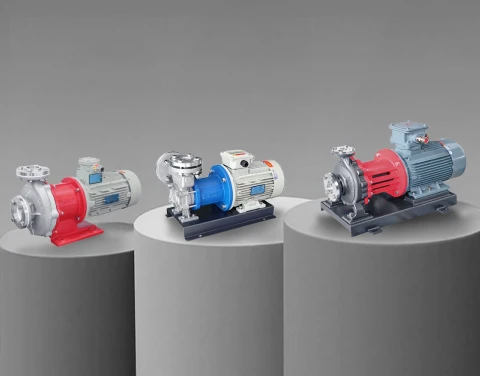
For clean solvent transfer, storage tank unloading and supply to production headers, the AMC(L) magnetic drive chemical process pump in 316L construction with pressureless-sintered silicon carbide bearings covers flows to 200 m³/h with hermetic containment and explosion-proof drive options. Where the solvent stream carries contamination, recycled content or acid residues from upstream processes, the AMC-F fluoropolymer-lined magnetic drive pump adds a chemically immune wetted path across the same containment architecture for flows from 3.6 to 100 m³/h. Both ranges are built on HG/T2730 dimensional standards, so retrofit into existing piping runs proceeds without spool modifications. For the full range of designs by fluid and duty class, see our chemical pump overview.
Send Your Solvent Duty for Engineering Review
Solvent pump selection converges quickly once four inputs are fixed: the fluid and its operating temperature range, the duty point in flow and head, the suction arrangement with line lengths and elevations, and the hazardous area classification of the installation point. With those, NPSH margin, hydraulic selection, bearing grade and drive rating can all be confirmed in a single engineering pass. Send your solvent list, duty points and site classification through our contact page, and the engineering team will return a configured selection with curves, material confirmation and installation notes.
