



Every steel pickling line, plating shop and electronics etching line produces a waste stream that resists tidy specification: mixed waste acid. Unlike a purchased chemical with a datasheet and a certificate of analysis, waste acid arrives at the transfer pump as whatever the process left behind, and its composition shifts with the production schedule, the bath dumping cycle and the season. A pump selected against last month's sample can face a stream this month that is twice as dense, warm instead of cold, and spiked with a halide that strips its metallurgy. Plants that treat waste acid transfer as ordinary acid duty cycle through corroded casings and seized bearings; plants that treat it as its own service class specify around the variability and run for years. This guide lays out what makes mixed waste acid a distinct pumping problem, the material and hydraulic decisions that follow, and the sealless configurations that hold up in this service.
What counts as mixed waste acid and where it comes from
| Source stream | Typical composition | Pumping challenge |
|---|---|---|
| Carbon steel pickling waste | Spent HCl, 3-10%, with dissolved iron | Chloride corrosion, density above 1.2, iron salt crystallization |
| Stainless steel pickling waste | HNO3 + HF mixture with Cr, Ni, Fe | Oxidizing acid plus fluoride, attacks metals and silicon ceramics |
| Electroplating rinse and dump waste | Mixed H2SO4, HCl, HNO3, metal salts | Unpredictable composition, occasional chromate or cyanide carryover |
| Electronics etching waste | H2SO4 + H2O2 or mixed mineral acids with Cu | Oxidizer-acid mixtures, temperature excursions, copper crystallization |
| Regeneration plant feed and product | Concentrated recovered acid, reheated | Elevated temperature, highest concentration in the loop |
Two features of this table drive pump engineering. First, every stream carries dissolved metals, which means specific gravity well above water, viscosities that climb as the stream cools, and salts ready to crystallize on any cold surface. Second, several streams combine an oxidizing acid with a halide, a pairing that attacks passive metals far more aggressively than either component alone. The transfer pump sees the harshest version of all of these, because waste consolidation sums every bath the plant runs. Selection begins from the worst credible envelope across all sources, with the understanding that the envelope will be exceeded occasionally and the design must survive that too.
Why standard specifications fail on waste acid duty
The failure pattern in waste acid service is consistent. A pump is selected for dilute sulfuric acid because that dominates the volume; a plating line dumps a chloride-bearing bath into the same collection pit; pitting and crevice corrosion begin in the stainless casing within weeks. Or the stream cools overnight in an idle line, ferrous chloride crystallizes in the wear ring clearances, and the morning startup strips the bearings. Or a warm concentrated batch arrives at the pump sized for ambient dilute acid, the motor overloads on the higher density, and the drive trips. Each failure traces to specification against a nominal case in a service defined by its variance. The correct starting point is the worst credible case across composition, temperature, density and solids loading, with sealless containment so that the inevitable excursions stay inside the pump.
Material selection for unknown and variable mixtures
Against an unknown mixture, the material decision simplifies: the wetted path must tolerate everything the plant can credibly produce. Austenitic stainless steels, including 316L, carry hard limits here. Chlorides drive pitting and stress corrosion cracking, fluorides attack the passive film, and oxidizing chloride mixtures defeat even high-alloy grades; a metallic casing on mixed waste acid is a corrosion experiment with an unknown end date. Fluoropolymer linings resolve the question by removing chemistry from it. PTFE and PFA are inert to hydrochloric, nitric, sulfuric and hydrofluoric acids across the full concentration and temperature range of waste acid service, so a one-piece lined casing covers every stream in the table and every plausible mixture of them. This is the same reasoning behind corrosion-resistant pump solutions for aggressive chemicals, applied to the service where the chemistry cannot be guaranteed in advance. One boundary condition deserves emphasis: where hydrofluoric acid is present, as in stainless pickling waste, silicon carbide bearings are attacked, and the bearing and shaft materials must be reviewed specifically for fluoride service with carbon-based bearing grades in the specification conversation.
Dissolved metals, crystallization and the flushing discipline
Spent pickling acid approaches saturation in dissolved metal salts, and saturation is a promise of crystals. Ferrous chloride, ferric chloride, nickel and chromium salts all drop out of solution when the stream cools, concentrates by evaporation, or mixes with a stream of different acidity. Inside a pump, crystals form first in the tightest clearances: the wear rings, the bearing gaps and the balance holes of the impeller. The defenses are procedural and geometric. Keep transfer lines short, sloped and free of dead legs where crystals can accumulate undisturbed. Flush the pump with water or with the incoming dilute stream after each batch transfer, and before any idle period long enough for the casing to reach ambient temperature. Where winter ambient temperatures are low, trace the suction line so the stream arrives above its crystallization point. A magnetic drive pump with generous internal passages and no seal cavity removes the crevice where crystallization does the most damage in sealed pumps, which is one of the documented advantages covered in mechanical seal versus magnetic drive pump comparisons for dirty services.
Off-gassing, NOx and the case for closed transfer
Waste acid with nitric content releases nitrogen oxide fumes when it contacts metals, when it is agitated, and when it warms. A leaking pump on this duty is a fume release event inside the plant, with occupational exposure limits measured in single-digit parts per million. Collection and transfer systems for nitric-bearing waste are therefore designed closed: sealed tanks, vented to scrubbers, with pumps that have no atmospheric leakage path. The sealless magnetic drive construction removes the dynamic shaft seal that constitutes that path in conventional pumps, which is the operational basis of leak-proof pump solutions for hazardous chemicals. For waste acid, the containment argument carries double weight: the stream is corrosive enough that any leak attacks surrounding equipment, and fuming enough that the same leak is a reportable exposure event.
Hydraulic sizing for a stream that changes density
Metal-laden waste acid runs dense. Spent hydrochloric pickling acid with dissolved iron commonly reaches specific gravities of 1.2 to 1.3, and concentrated regeneration product can exceed 1.4. Pump sizing must follow the physics. Head is a pressure term divided by density, so a pump delivering a given head moves a denser stream to a lower elevation than the same head on water; confirm the duty point in pressure terms against the heaviest credible batch. Power scales directly with density, so the motor must be sized at the maximum credible specific gravity with margin for viscosity, which also rises with metal loading and falling temperature. Operating far left of the best efficiency point recirculates heat into a stream already prone to crystallization, so select the hydraulic size for the actual flow range of the transfer operation, and use the drive turndown for batch-to-batch variation. Where the waste acid originates in surface finishing operations, the application context in electroplating and PCB surface finishing pump selection covers the upstream duties feeding the same collection system.
Recommended configurations for mixed waste acid service
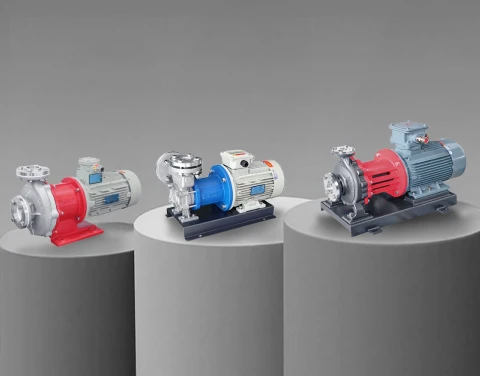
For waste acid collection, transfer to treatment, and regeneration plant feed, the AMC-F chemical standard PTFE-lined magnetic drive pump is the standard configuration: a one-piece F46 or PFA lined casing inert to every acid and mixture in this class, built to HG/T2730 standard dimensions, covering 3.6 to 100 m3/h and 20 to 80 m of head, with bearing systems specified against the actual stream including fluoride-bearing duties. Where long-term records prove the stream is a single, halide-free dilute acid of stable composition, metallic construction becomes defensible, and the AMC(L) chemical process magnetic drive pump in suitable alloys extends the envelope to 200 m3/h. In practice, waste streams rarely stay that well-behaved, and the lined configuration earns its place by making composition the plant's problem instead of the pump's.
Send your waste acid profile for engineering review
Waste acid pump selection converges on five inputs: the list of process streams feeding the collection system with their acid types and concentrations, the temperature range including regeneration duty, the maximum credible specific gravity, the solids and crystallization history of the stream, and the duty points for each transfer operation. With those, wetted materials, bearing grades, hydraulics and motor sizing can be confirmed in one engineering pass, and the configuration that survives your worst batch gets specified instead of your average one. Send your stream list and duty points through our contact page, and the engineering team will return a configured selection with materials confirmation and installation notes.
