


Hydrochloric acid occupies a special place in pump engineering: it is one of the most widely used industrial chemicals, found in steel pickling, water treatment, chemical synthesis and food processing, and it is also one of the few common acids for which the standard metallic pump catalogue is almost entirely useless. Carbon steel dissolves on contact. Type 304 and 316L stainless steels, the workhorses of general chemical service, pit and crack in dilute acid within weeks. Even alloys considered exotic for other duties survive only in narrow windows of concentration and temperature. At the same time, commercial acid at 30 to 37 percent fumes hydrogen chloride gas at room temperature, adding venting and containment demands that catch out designs copied from sulfuric or nitric service. This guide sets out what actually works: the chloride corrosion mechanisms, the material families that survive them, the fuming and off-gassing behaviour that shapes suction design, and the sealless configurations that keep hydrochloric acid contained from tanker to process.
Why Chloride Chemistry Defeats Standard Pump Metals
The chloride ion is small, mobile and aggressive toward the passive films that protect stainless steels. Where sulfuric acid above 93 percent passivates carbon steel and nitric acid passivates stainless, hydrochloric acid offers no such refuge at any commercially relevant concentration. The attack comes in three forms. General corrosion dissolves carbon steel and cast iron at rates measured in millimetres per year even at low concentration. Pitting corrosion perforates 304 and 316L through localised film breakdown, and the pits are nearly invisible until the casing weeps. Chloride stress corrosion cracking, the most dangerous of the three, fractures austenitic stainless under residual or applied stress, often with no measurable wall loss beforehand. Temperature multiplies all three: a 316L component that survives a cool, dilute flush can fail during the first hot cleaning cycle. The engineering conclusion is blunt: for hydrochloric acid transfer, the wetted set must be non-metallic or fluoropolymer-lined, and the metallic option should be treated as closed for concentrations above trace levels.
Material Selection: What Survives and What Does Not
The table below summarises wetted-material behaviour for hydrochloric acid transfer at near-ambient temperature. Confirm every selection against corrosion data for your actual concentration, temperature and impurity profile.
| Material | Behaviour in HCl | Verdict for pump wetted parts |
|---|---|---|
| Carbon steel / cast iron | Rapid general corrosion at all concentrations | Excluded |
| 304 / 316L stainless | Pitting and stress corrosion cracking, accelerated by heat | Excluded for process duty |
| High-nickel alloys (Alloy B-2, C-276) | Serviceable in defined windows; oxidising impurities reverse the picture | Specialist use only, costly |
| Titanium | Attacked in reducing acid without oxidising inhibitors | Generally excluded |
| PP / PVDF solid plastics | Good resistance; temperature ceilings of roughly 80 and 100 deg C | Suitable for light duty |
| PTFE / PFA (F46) lining | Essentially inert across 0 to 37 percent to over 100 deg C | Preferred default |
Two practical notes follow. First, impurity chemistry matters: ferric contamination in pickling returns makes the acid oxidising, which worsens attack on nickel-molybdenum alloys but leaves fluoropolymers indifferent. Second, gaskets and O-rings follow the same rules as casings; specify PTFE envelope gaskets and FFKM or PTFE-encapsulated seals, because a single EPDM joint can undo an otherwise correct material selection.
Fuming, Off-Gassing and What They Do to the Pump
Commercial hydrochloric acid is a solution of hydrogen chloride gas in water, and the gas wants out. At 37 percent and 20 deg C the vapour pressure of HCl over the liquid exceeds 30 kPa, which is why open tanks of muriatic acid visibly fume. For the pump this has three consequences. First, suction lines running warm or under vacuum can strip HCl gas from solution and vapour-lock the impeller, so NPSH available must be calculated against the true vapour pressure of the acid at its actual temperature, not against water-like assumptions. Second, gas accumulation in a shut-off or standby casing raises pressure and drives acid mist through any available leak path. Third, the fumes themselves attack nearby carbon steel structures, electrical enclosures and instruments, which shapes where the pump can be installed and how it is vented. Our guide to pumping gas-entrained and off-gassing fluids covers the hydraulic side of this behaviour in more depth.
Suction Design, NPSH and Priming
Because hydrochloric acid evolves gas, flooded suction is strongly preferred over suction lift; where lift is unavoidable, keep it short, steep and airtight, since every micro-leak on the suction side draws in air and accelerates gas-lock. Size the suction line one diameter above the pump nozzle, slope it continuously toward the pump, and avoid high points entirely. Calculate NPSH available with the vapour pressure of the acid at its maximum expected temperature, then hold the usual margin of at least 0.5 to 1 m over the pump's NPSH required. A structured walkthrough of the calculation appears in our guide to sizing a pump for flow, head and NPSH. Note also the density correction: 37 percent acid has a specific gravity near 1.19, which modestly raises shaft power and discharge pressure compared with water duty.
Containment: Seals Are the Weak Point in Acid Service
Every hydrochloric acid pump with a shaft seal is a leak waiting for a maintenance window. Seal faces in carbon or ceramic survive the acid, but the elastomers, springs and metal drive components around them live in an environment of HCl vapour, and their failure releases acid at shaft speed. Double seals with pressurised barrier fluid reduce the risk at the cost of a support system that itself needs monitoring. Magnetic drive construction removes the issue structurally: a stationary containment shell separates the fluid from the drive train, torque passes through the shell by magnetic coupling, and the only remaining leak paths are static PTFE gaskets. The maintenance and downtime economics of this choice are quantified in our analysis of sealed versus sealless pump total cost of ownership, and the wider containment strategy for hazardous media is covered in our guide to leak-proof pump solutions for hazardous chemicals.
Dosing and Low-Flow Duties
A large share of hydrochloric acid consumption goes to dosing duty instead of bulk transfer: pH correction in water treatment, regeneration of ion exchangers, descaling. These duties share the same material rules but add turndown and accuracy requirements. Centrifugal mag-drive pumps handle transfer and recirculation; where precise stroke-controlled metering is needed, pair a corrosion-proof metering pump with a lined transfer unit feeding it. Our guide to chemical dosing pump selection for water treatment covers duty profiles, turndown and verification in that application class. Whichever metering technology is chosen, keep a lined transfer pump upstream so that day-tank filling never relies on the dosing unit itself.
Recommended Configurations for Hydrochloric Acid Service
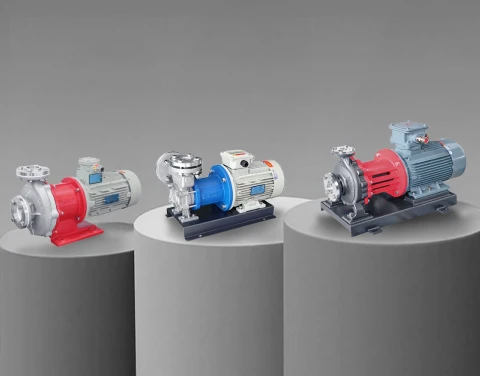
For transfer, recirculation, unloading and feed duty across the full 0 to 37 percent range, the Aulank AMC-F PTFE-lined magnetic drive pump is the standard recommendation. Its one-piece F46/PFA lining isolates every wetted surface from chloride attack, sintered silicon carbide bearings tolerate the fluid's low lubricity, and the sealless design eliminates the leak path that dominates acid pump maintenance records. The range covers 3.6 to 100 m³/h at heads of 20 to 80 m, manufactured and tested under the HG/T2730 magnetic pump standard, with PTFE static gaskets throughout. For plants that also handle compatible alkaline streams on adjacent skids, the metallic AMC-L magnetic drive pump in 316L serves those side duties, keeping the lined fleet dedicated to chloride service. Both ranges support customised impeller trims and material certification for the wetted set.
If you are specifying a hydrochloric acid pump for pickling, regeneration, dosing or unloading duty, contact the Aulank engineering team with your concentration, temperature, flow and head figures. We will return a material recommendation and a sized selection, typically within one working day.
