


Sodium hydroxide — caustic soda — ranks among the highest-volume industrial chemicals in the world, and among the most commonly mishandled in pump specification. The fluid looks deceptively simple: no chloride pitting, no strong oxidizing behaviour, and corrosion tables show several metals surviving it. Yet caustic service quietly destroys pumps through three mechanisms that catalogues rarely mention together — crystallization that locks seal faces, density and viscosity that overload motors sized for water, and caustic embrittlement that cracks carbon steel weldments in hot concentrated duty. This guide lays out the engineering that actually governs caustic pump selection: the material windows defined by concentration and temperature, the hydraulic corrections demanded by a fluid 53 percent denser and up to eighty times more viscous than water, the crystallization behaviour that makes the mechanical seal the weakest component in the loop, and the sealless configurations that keep NaOH contained from storage tank to process.
Why Caustic Soda Punishes Generic Pump Choices
Three physical properties separate caustic service from ordinary chemical duty. First, concentration and temperature interact: the same carbon steel that survives 20 percent caustic at ambient temperature for decades can crack within months at 50 percent and 80 °C, so material decisions belong on the caustic soda service chart, never on a generic corrosion table alone. Second, commercial 50 percent caustic is a heavy, syrupy liquid — specific gravity about 1.53, viscosity near 80 cP at 20 °C — and it begins to freeze around 12 °C, which sits inside the range of an unheated pump room in winter. Third, caustic crystallizes wherever solution meets air and dries, so every microscopic weep at a seal face grows a hard crust that scores the faces and wedges them apart. A pump selected on flow and head alone will meet all three failure modes within its first year; a pump selected with caustic-specific corrections will run for a decade between interventions.
Material Selection: What Works and What Fails
The table below summarizes wetted-material behaviour across the commercial concentration range at near-ambient temperature. Always confirm the final choice against the caustic service chart for your actual concentration–temperature point, since the boundaries shift with heat.
| Material | Behaviour in NaOH | Verdict for wetted parts |
|---|---|---|
| Carbon steel | Sound below ~50% at ambient; embrittlement risk rises with temperature and strength | Acceptable with stress-relieved welds, per service chart |
| Stainless 304 / 316L | Good resistance up to 50% at ambient and moderate temperatures | Standard metallic choice |
| Nickel 200 / nickel alloys | Excellent even in hot concentrated and near-anhydrous service | Premium choice for severe duty |
| Aluminium, zinc, tin alloys | Rapidly attacked by strong base, with hydrogen evolution | Excluded |
| Polypropylene (PP) | Excellent resistance to about 80 °C | Sound for light duty and lined piping |
| PVDF | Attacked by strong caustic despite broad acid resistance | Avoid for NaOH |
| PTFE / PFA (F46) lining | Fully resistant at all commercial concentrations | Preferred lining standard |
Elastomers follow their own logic in caustic duty. EPDM is the workhorse gasket and O-ring material for NaOH, and PTFE envelope gaskets cover everything else. The classic mistake is specifying FKM (Viton) by habit from acid service: FKM degrades quickly in strong caustic and belongs nowhere near it. For a broader view of material screening across aggressive media, see our guide to corrosion-resistant pump solutions for aggressive chemicals.
Density, Viscosity, and Freezing: Hydraulic Design for 50% Caustic
Hydraulic design for 50 percent caustic starts from corrected numbers, not water numbers. At specific gravity 1.53, every metre of liquid column and every kilowatt of shaft power scales up by roughly half compared with water; a motor that looks adequate on the water curve will trip on overload in caustic at the same duty point. Viscosity adds a second correction: at 80 cP, centrifugal head, flow, and efficiency all derate under the Hydraulic Institute viscosity correction method, and friction losses in undersized suction lines climb steeply. The practical response is a suction line one size above the pump nozzle, generous straight runs, flooded suction wherever possible, and NPSH available computed at the lowest expected product temperature, where viscosity peaks. A structured walkthrough of the calculation appears in our guide to sizing a pump by flow, head, and NPSH.
Freezing behaviour completes the picture. Since 50 percent caustic begins to crystallize near 12 °C, storage and piping are normally held between roughly 20 and 40 °C, with tracing or insulation on outdoor lines and a drain-and-flush routine for idle standby pumps. Dilution is strongly exothermic: where 50 percent product is let down in-line to a working strength, the temperature rise can push a marginal material point across a service-chart boundary, so the verification must be made at the diluted, heated condition.
Crystallization: The Hidden Seal Killer
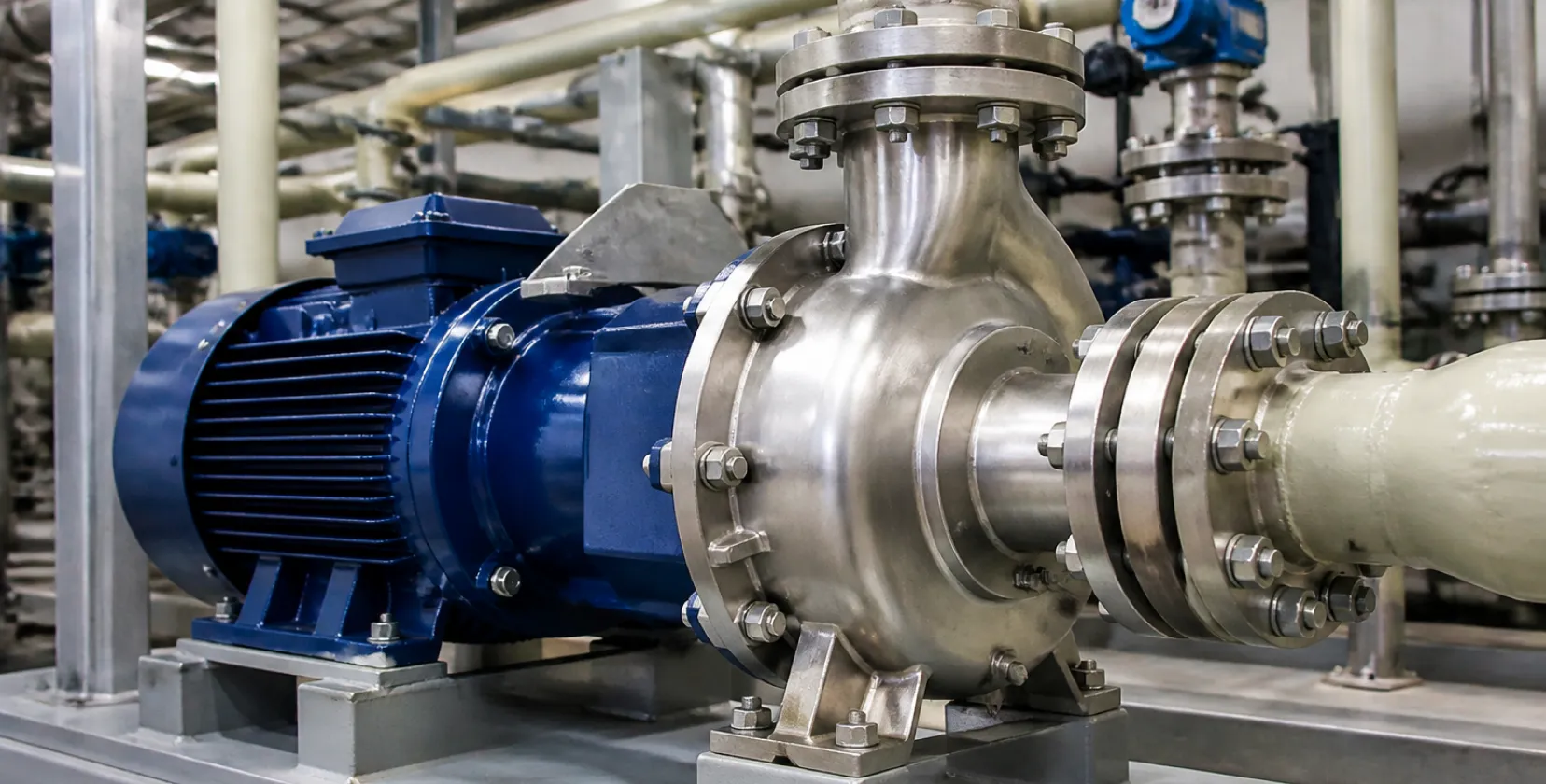
Every caustic pump with a shaft seal carries a self-destruct mechanism. NaOH solution migrates across the seal faces, meets air, and crystallizes into a hard, abrasive crust. The crust scores the faces, holds them apart at standstill, and guarantees a burst of leakage at every restart — which grows more crust. Operators read the white deposit around a caustic pump as routine housekeeping; it is actually a seal failure in progress. External quench arrangements slow the crusting at the cost of water consumption and product dilution. A magnetic drive pump removes the failure mode structurally: a stationary containment shell separates the fluid from the drive train, torque crosses the shell by magnetic coupling, and the only remaining leak paths are static PTFE gaskets that never see rotation. The maintenance and downtime economics of this choice are quantified in our analysis of pump total cost of ownership for sealed versus sealless designs, and the wider containment strategy for hazardous media is covered in our guide to leak-proof pump solutions for hazardous chemicals.
Caustic Embrittlement and Temperature Limits
Caustic stress-corrosion cracking — historically called caustic embrittlement — is the metallurgical trap in NaOH service. Carbon steel that passes every corrosion-rate test can crack suddenly along stressed zones, particularly welds, when concentration and temperature climb together. The caustic soda service chart maps the boundary: at low concentration and ambient temperature plain carbon steel is sound; moving up in either variable pushes the service into a region where weldments must be stress-relieved, and eventually into nickel territory. Two rules follow. Specify stress-relieved, post-weld heat-treated fabrications for any caustic duty beyond the mild region, and treat every process change — a hotter cleaning cycle, a stronger make-up solution — as a formal re-check of the material point on the chart. Austenitic stainless steels resist caustic cracking far better than carbon steel, although hot concentrated caustic above roughly 100 °C moves even 316L toward nickel alloys.
Dosing and Low-Flow Duties
A large share of caustic consumption is metering duty: pH correction in water and wastewater treatment, soap and detergent production, clean-in-place solution make-up. These duties inherit every material rule above and add turndown and accuracy requirements on top. Diaphragm metering pumps with PTFE diaphragms and PP or PTFE liquid ends handle the injection itself, fed by a transfer pump that keeps the day tank filled. Duty profiles, turndown, and calibration practice in this application class are covered in our guide to water treatment chemical dosing pump selection. Keep the transfer and dosing functions on separate machines so the metering pump never has to pull from a bulk tank through long suction runs.
Recommended Pump Configurations for Caustic Service
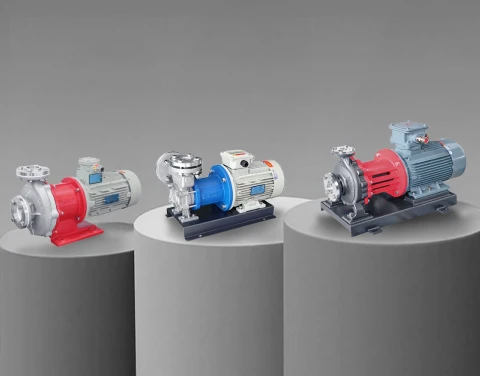
For transfer, recirculation, unloading, and feed duty from dilute solution up to 50 percent product at ambient and moderate temperatures, the standard recommendation is the Aulank AMC-L metallic magnetic drive pump in 316L. Its sealless containment eliminates the crystallizing leak path that dominates caustic pump maintenance records, sintered silicon carbide bearings tolerate the fluid, and the series covers flows to 200 m³/h with heads to 80 m, manufactured and tested to the HG/T2730 magnetic pump standard with material certification on the wetted kit. Where the same frame must also handle mixed CIP chemistries, acidic rinses, or other aggressive media, the fluoropolymer-lined AMC-F provides a universal wetted path from 3.6 to 100 m³/h with a one-piece F46/PFA lining, so one spare-parts philosophy covers the whole utility area. For hot concentrated duty approaching the nickel region of the service chart, we engineer custom wetted configurations on request.
If you are specifying a caustic soda pump for transfer, dosing, unloading, or CIP duty, contact the Aulank engineering team with your concentration, temperature, flow, and head. We will return a material recommendation and a duty-corrected selection, typically within one working day.
