


Organic Rankine Cycle (ORC) technology forms the backbone of modern waste heat recovery, geothermal power generation, and biomass energy conversion. By utilizing highly volatile organic working fluids—such as n-pentane, toluene, siloxanes, and engineered hydrofluorocarbons (e.g., R245fa)—instead of water, ORC systems can generate electrical power from low-grade thermal sources. The most structurally demanding component within this closed-loop thermodynamic cycle is the feed pump. This pump is responsible for drawing the condensed liquid organic fluid from the condenser and pressurizing it into the high-temperature evaporator. This specific operational node dictates that the pump must handle highly volatile, flammable, and low-viscosity fluids precisely at their saturation point (boiling curve). Consequently, standard mechanically sealed centrifugal pumps suffer from chronic cavitation, vapor lock, and catastrophic dynamic seal failure, leading to hazardous fugitive emissions. This engineering guide details the structural necessity of sealless fluid containment in ORC systems, examining how specific magnetic drive architectures, including the MDW and MDH series, eradicate dynamic seal flashing, process severe two-phase flow, and deliver the high-head hydraulic stability required for continuous waste heat recovery operations.
The Thermodynamic Challenge: Low NPSHa and Fluid Saturation
The fundamental engineering challenge of the ORC feed pump lies in fluid thermodynamics. The fluid exiting the condenser is entirely saturated; it is exactly at the boundary of its liquid-gas phase transition. In fluid mechanics, this translates to a critically low Net Positive Suction Head available (NPSHa).
When pumping saturated liquid, any minor frictional pressure drop in the suction piping—caused by pipe friction, elbows, or valves—lowers the local static pressure below the fluid's vapor pressure. Furthermore, as the fluid accelerates into the eye of a standard centrifugal impeller, Bernoulli's principle dictates a corresponding drop in localized pressure. This instantly causes a portion of the organic fluid to flash into vapor bubbles. When these bubbles pass into the higher-pressure zones of the volute, they collapse violently. This phenomenon, known as cavitation, generates localized micro-jets that rapidly erode the pump's internal metallurgy and destabilize the rotating assembly.
Vapor Lock in Standard Centrifugal Hydraulics
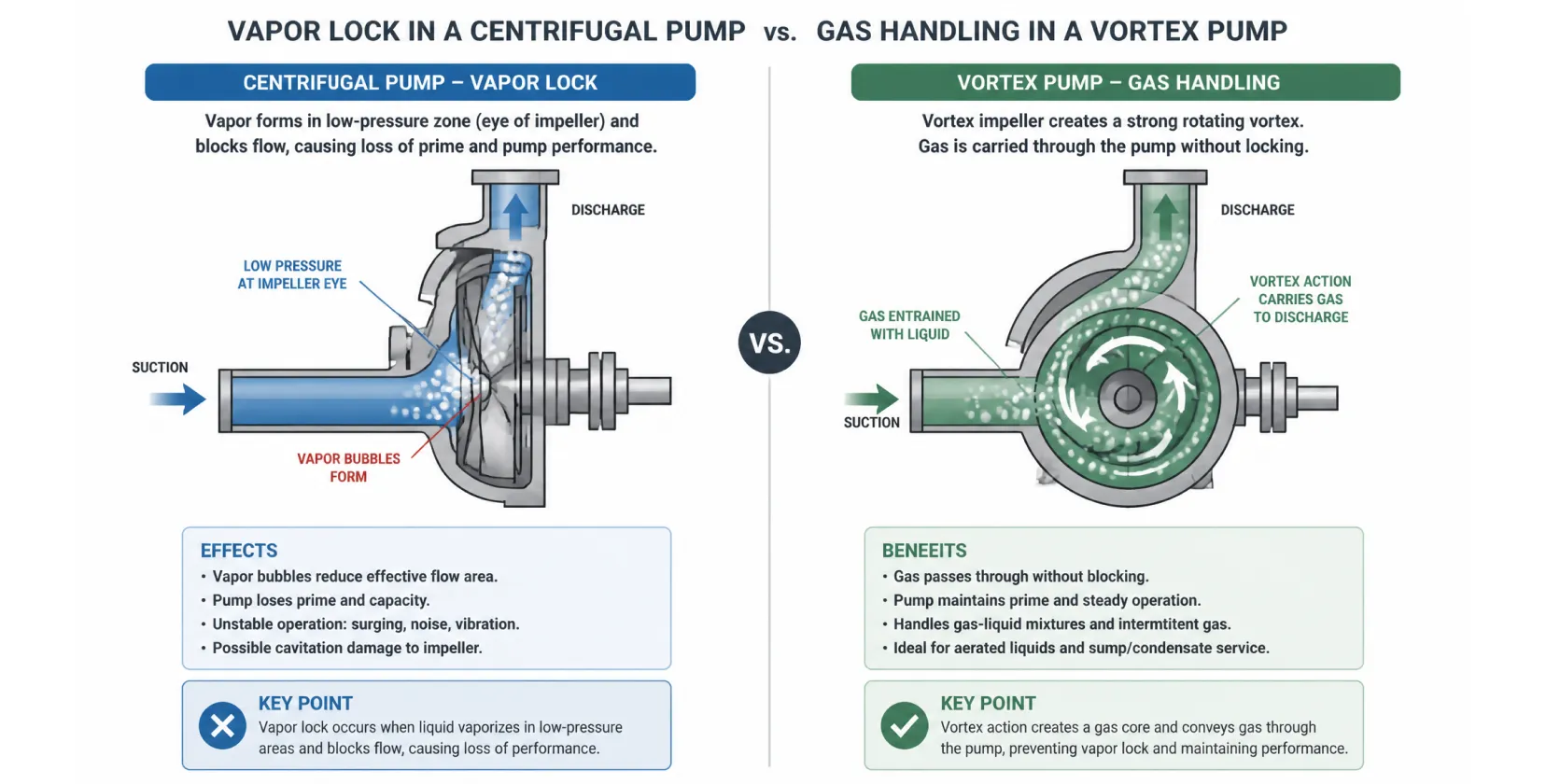
Beyond mechanical erosion, cavitation induces a severe hydraulic failure known as vapor lock (or gas binding). Standard centrifugal impellers are engineered exclusively to process incompressible liquids. Because gases possess a lower specific gravity than liquids, centrifugal force drives the heavier liquid outward, trapping the lighter flashed vapor at the center of the impeller (the eye).
When the entrained gas volume exceeds approximately 3% to 5%, the vapor pocket grows large enough to completely block incoming liquid. The impeller spins uselessly inside a dry pocket of gas, immediately ceasing fluid delivery to the evaporator. The ORC power cycle halts entirely, and the pump's internal components rapidly overheat due to a total loss of fluid cooling.
Vortex Hydraulics for Low-NPSHa Stability
To resolve the persistent vapor lock inherent to saturated liquid transfer, process engineers specify the vortex pump architecture for ORC feed systems. A vortex (regenerative peripheral) pump operates on an entirely different fluid dynamic principle.
The vortex impeller features dozens of precision-machined radial vanes that rotate within a symmetrical annular channel. Instead of relying purely on centrifugal acceleration, the impeller continuously transfers kinetic energy to the fluid in a high-velocity, spiraling motion. This intense internal turbulence fundamentally alters two-phase flow processing. Rather than allowing flashed vapor to accumulate at a central eye, the regenerative action aggressively chops, compresses, and sweeps the gas bubbles through the peripheral channel. This hydraulic geometry allows the vortex magnetic drive pump to continuously process up to 20% entrained gas by volume without losing prime or experiencing vapor lock, ensuring uninterrupted flow to the ORC evaporator even during severe transient pressure drops.
Seal Face Flashing and ATEX Containment
While fluid flashing disrupts centrifugal hydraulics, it completely destroys dynamic mechanical seals. Mechanical seals maintain separation between the high-pressure fluid and the atmosphere by utilizing a microscopic liquid film between a rotating and a stationary lapped face.
The sliding contact of these faces inherently generates friction heat. When pumping volatile ORC fluids near their boiling point, this localized friction provides immediate activation energy, causing the thin lubricating film to boil instantly into gas. This strips the seal of its hydrodynamic lubrication, forcing the faces into a state of dry friction. The resulting thermal shock causes the carbon and silicon carbide faces to shatter. Because ORC working fluids (like pentane or toluene) are highly flammable, a blown mechanical seal results in the catastrophic release of explosive vapors into the facility, representing a critical ATEX safety violation.
The Sealless Magnetic Drive Boundary
The structural solution to dry-running and fugitive emissions is the absolute elimination of the dynamic shaft penetration. Sealless magnetic drive architectures replace the physical drive shaft with a synchronized magnetic coupling separated by a stationary containment shell (isolation sleeve).
Constructed from heavy-walled 316L stainless steel or Hastelloy, this isolation sleeve acts as a static, hermetic pressure boundary. There are no rotating seals, packing glands, or secondary elastomeric O-rings intersecting the dynamic fluid envelope. Consequently, there is zero pathway for the volatile organic fluid to escape. The working fluid remains hermetically locked within the closed-loop cycle, structurally preventing fugitive emissions, guaranteeing compliance with stringent environmental regulations, and securing plant safety in explosive zones.
Tribology in Ultra-Low Viscosity Solvents: SSiC Bearings
In a magnetic drive feed pump, the inner rotor assembly is fully submerged and must be supported by internal journal bearings lubricated solely by the ORC working fluid. Volatile organic fluids possess exceptionally low kinematic viscosity (frequently below 0.3 cP), offering virtually zero natural hydrodynamic lubricity.
Standard bearing materials, such as bronze or carbon-graphite, cannot establish a stable fluid film in these conditions and will rapidly undergo boundary friction, overheating, and galling. Process engineers mandate Sintered Silicon Carbide (SSiC) for all internal wetted bearings and thrust washers. SSiC is a single-phase ceramic offering extreme mechanical hardness, absolute chemical inertness, and a remarkably low coefficient of friction. Its superior thermal conductivity rapidly dissipates minor internal frictional heat, preventing localized fluid boiling within the precision bearing clearances and ensuring tens of thousands of hours of wear-free operation.
Suppressing Radial Thrust in High-Head Feed Operations
The ORC feed pump must inject the working fluid into a high-pressure evaporator, requiring massive differential head. When standard centrifugal pumps are forced to operate against severe systemic backpressure, they function far to the left of their Best Efficiency Point (BEP). This creates asymmetric pressure distributions within the volute, generating extreme radial thrust forces that violently deflect the rotating shaft and crush internal bearings.
The symmetrical annular channel of a vortex regenerative pump structurally neutralizes radial thrust. The fluid pressure is distributed evenly around the entire circumference of the impeller, resulting in zero shaft deflection. This allows the vortex architecture to safely generate differential pressures up to ten times higher than a centrifugal impeller of equivalent diameter, perfectly matching the high-head, low-flow requirements of advanced ORC heat recovery systems.
Conclusion
The precise thermodynamic balance of Organic Rankine Cycle systems exposes the fundamental vulnerabilities of mechanically sealed centrifugal pumps. Operating with saturated, highly volatile organic fluids guarantees low-NPSHa cavitation, vapor lock, and catastrophic dynamic seal failure. By transitioning to sealless magnetic drive architectures equipped with heavy-walled containment shells, SSiC tribology, and regenerative vortex hydraulics, engineers establish an indestructible, hermetic fluid boundary. This structural integration ensures continuous, zero-leakage fluid pressurization, preventing explosive vapor releases and maximizing the efficiency of industrial waste heat recovery infrastructure.
Engineered Fluid Solutions with Aulank Pump
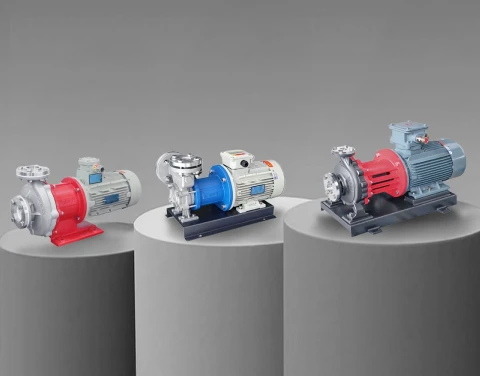
Aulank Pump designs specialized sealless fluid transfer equipment explicitly engineered for closed-loop thermodynamic cycles, waste heat recovery, and hazardous chemical processing. Our high-performance magnetic drive pumps provide the absolute hermetic containment required to safely pressurize volatile organic working fluids, explosive refrigerants, and aggressive solvents. By combining heavy-walled austenitic stainless steel metallurgy with advanced regenerative vortex hydraulics, as seen in our MDP Permanent-Magnet Canned Vortex Magnetic Drive Pump, Aulank delivers exceptional gas-handling capabilities and zero-leakage reliability under severe systemic pressure. Consult our engineering team for precise NPSH calculations, ATEX-compliant sizing, and system integration support for your advanced ORC power generation facility.
