


Within modern petroleum refining, the Hydrofluoric Acid (HF) alkylation unit is responsible for combining low-value olefins (such as propylene or butylene) with isobutane to produce high-octane, clean-burning alkylate for premium motor fuels. The catalyst driving this reaction is anhydrous Hydrofluoric Acid (HF), an aggressively corrosive and extraordinarily toxic chemical. Pumping anhydrous HF and acid-hydrocarbon emulsions presents the single highest-risk fluid transfer application in a refinery. Anhydrous HF possesses a boiling point of merely 19.5°C (67.1°F). If released to the atmosphere, it instantly flashes into a dense, ground-hugging aerosolized vapor cloud that is lethal upon inhalation or dermal contact. Traditional API 610 centrifugal pumps utilizing dynamic mechanical seals—even those equipped with complex dual-seal flush plans—harbor an inherent mechanical vulnerability. The dynamic sliding faces inevitably degrade, creating a direct pathway for atmospheric release. This engineering guide details the structural mandate for sealless fluid containment in HF alkylation units, examining how specific magnetic drive architectures, including the MDW and MDH series, eradicate lethal vapor emissions, resolve the severe chemical dissolution of standard silicon bearings, and deliver the high-head hydraulic stability required for continuous acid catalyst injection.
Mechanical Seal Failure and Lethal Vapor Cloud Formation
The primary engineering threat in an HF alkylation unit is the thermodynamic volatility of the acid catalyst. Mechanical seals maintain fluid separation by pressing a rotating face against a stationary face, utilizing a microscopic film of the pumped HF fluid to provide hydrodynamic lubrication.
This dynamic boundary represents a chronic point of failure. The sliding contact of the seal faces generates localized friction heat. Because HF boils at 19.5°C, this friction heat rapidly vaporizes the lubricating film. The mechanical seal is forced into a state of boundary friction (dry running), which induces extreme thermal shock, surface scoring, and the eventual shattering of the carbon or ceramic faces.
Once the seal geometry is compromised, high-pressure anhydrous HF breaches the pump casing. Upon contacting atmospheric pressure, the liquid HF flashes violently into a gas. Because HF vapor strongly hydrogen-bonds with atmospheric moisture, it forms a dense, heavy aerosol cloud of concentrated hydrofluoric acid droplets. This ground-hugging cloud does not readily disperse; it drifts along the facility floor, posing a catastrophic mass-casualty threat to plant personnel and requiring immense water mitigation cannons to suppress. The inherent risk of seal degradation mandates a structural shift away from dynamic shaft penetrations.
API 685 and Hermetic Magnetic Drive Containment
To structurally eliminate the possibility of a vapor cloud release, refineries are increasingly enforcing API 685 standards—the stringent specification for sealless magnetic drive pumps in heavy-duty petrochemical service. A magnetic drive architecture entirely removes the physical drive shaft that connects the electric motor to the impeller.
Power is transmitted through a synchronized magnetic coupling separated by a heavy-walled, stationary containment shell (isolation sleeve). This metallic shell establishes a permanent, static pressure boundary between the highly toxic HF catalyst and the external environment. Because there are no rotating seals, packing glands, or dynamic O-rings intersecting the fluid envelope, there is zero pathway for fluid extrusion or vapor flashing. The anhydrous HF remains hermetically locked within the casing, guaranteeing absolute zero-leakage continuous operation and securing the facility against lethal fugitive emissions.
Tribology in HF Acid: The Free-Silicon Vulnerability
In a sealless magnetic drive pump, the inner rotor assembly operates fully submerged in the acid and is supported by internal journal bearings that rely on the pumped fluid for lubrication. Hydrofluoric acid is chemically unique: it is one of the only acids capable of aggressively attacking and dissolving silica and silicon-based compounds.
This specific chemical trait dictates strict tribological selection. Standard pump bearings are often manufactured from Reaction-Bonded Silicon Carbide (RBSiC). The manufacturing process of RBSiC leaves a matrix containing 10% to 15% "free silicon" interspersed between the carbide grains. When exposed to anhydrous HF, the acid rapidly attacks and dissolves this free silicon network. Within a few days of operation, the bearing loses its structural integrity, transforming into a porous, crumbling sponge. This leads to immediate bearing collapse, catastrophic rotor seizure, and the destruction of the magnetic coupling.
Process engineers explicitly mandate Alpha Sintered Silicon Carbide (α-SSiC) or solid Tungsten Carbide (WC) for all internal wetted bearings in HF service. Alpha-SSiC is a single-phase ceramic manufactured through high-temperature sintering with no free silicon. It exhibits absolute chemical inertness against hydrofluoric acid, alongside extreme mechanical hardness. Its superior tribological properties allow it to establish a stable hydrodynamic fluid film in low-viscosity acid-hydrocarbon emulsions, ensuring tens of thousands of hours of continuous, wear-free operation without chemical degradation.
Metallurgical Strictures: Monel 400 and Fluoride Passivation
Hydrofluoric acid actively corrodes most standard industrial metals, including 304, 316L, and duplex stainless steels. The acid rapidly attacks the chromium matrix of stainless steel, leading to severe general thinning, intergranular corrosion, and stress corrosion cracking (SCC) under high pressure.
For the structural integrity of the pump volute and the hermetic containment shell, the petroleum industry specifies Monel 400 (a solid solution nickel-copper alloy) or specialized Hastelloy grades (such as C-276). Monel 400 demonstrates exceptional resistance to anhydrous HF across a wide range of temperatures and concentrations. When exposed to HF, the nickel-copper matrix reacts to form a tightly adhering, impermeable layer of nickel fluoride and copper fluoride. This passive fluoride film essentially shields the underlying metal from further acid attack, ensuring the heavy-walled pressure boundary remains impenetrable over decades of severe refinery duty.
Vortex Hydraulics for Catalyst Injection Stability
The fluid dynamics within an alkylation unit require the HF catalyst to be injected continuously into the high-pressure alkylation contactor vessel, where it vigorously mixes with the olefin and isobutane feedstocks. This injection process dictates a hydraulic profile featuring high differential head and relatively low volumetric flow.
When standard centrifugal pumps are forced to operate against this high systemic backpressure, they function at the extreme left side of their performance curve (far from the Best Efficiency Point). This generates an asymmetrical pressure distribution within the volute, creating massive radial thrust. In a high-density acid environment, this radial thrust violently deflects the rotating shaft, crushing the internal bearings and causing the inner magnetic rotor to scrape against the containment shell.
To structurally neutralize radial shaft deflection, engineers utilize the vortex pump architecture for HF acid injection. A vortex (regenerative peripheral) impeller transfers kinetic energy continuously in a balanced, spiraling motion around a fully symmetrical annular channel. This 360-degree hydraulic symmetry completely eliminates radial thrust forces, regardless of the downstream contactor backpressure. Furthermore, a single-stage vortex pump generates differential pressure up to ten times higher than a centrifugal pump of equivalent diameter. This allows the pump to deliver a stable, highly linear injection of the HF catalyst without suffering mechanical degradation.
Handling Acid-Hydrocarbon Emulsions and Two-Phase Flow
In addition to pure acid transfer, pumps in the alkylation unit must often circulate acid-hydrocarbon emulsions and handle potential fluid flashing due to the high volatility of isobutane and HF. Standard centrifugal impellers are highly susceptible to vapor lock when entrained hydrocarbon gases or flashed HF vapors accumulate in the low-pressure suction eye.
The intense internal turbulence generated by the regenerative vortex impeller aggressively chops and compresses any entrained vapor bubbles, preventing gas accumulation at the center of the pump. By keeping the gases suspended and uniformly mixed within the liquid emulsion, the vortex magnetic drive pump can successfully process up to 20% entrained gas by volume. This hydraulic resilience ensures that the alkylation process remains uninterrupted even during severe temperature spikes or transient pressure drops in the unit.
Conclusion
The extreme toxicity and unique corrosive properties of anhydrous Hydrofluoric Acid demand zero-compromise fluid containment architectures. Relying on mechanically sealed pumps in an HF alkylation unit guarantees seal-face degradation, flashing, and the catastrophic release of lethal vapor clouds. By transitioning to API 685 compliant sealless magnetic drive architectures—equipped with heavy-walled Monel 400 containment shells, free-silicon-devoid Alpha-SSiC tribology, and regenerative vortex hydraulics—refinery operators establish an indestructible fluid boundary. This structural integration neutralizes radial thrust, prevents bearing dissolution, and ensures the absolute zero-leakage performance necessary to protect human life and maintain continuous high-octane fuel production.
Engineered Fluid Solutions with Aulank Pump
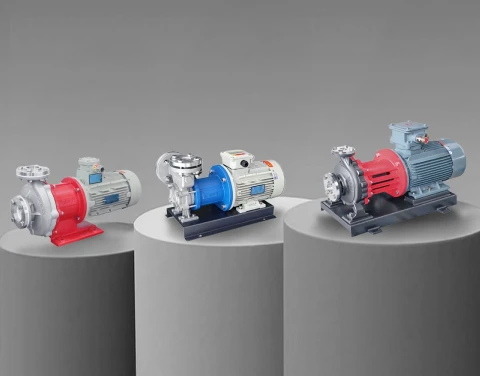
Aulank Pump designs specialized sealless fluid transfer equipment explicitly engineered for the most severe hazardous material processing and petrochemical refining applications. Our high-performance magnetic drive pumps provide the absolute hermetic containment required to safely process highly toxic, corrosive, and volatile chemicals like anhydrous Hydrofluoric Acid. By combining advanced Monel metallurgy, Alpha-SSiC bearing technology, and regenerative vortex hydraulics, as seen in our MDP Permanent-Magnet Canned Vortex Magnetic Drive Pump, Aulank delivers exceptional high-head stability and zero-leakage reliability under intense refinery stress. Consult our engineering team for precise API 685 compliance sizing, alloy passivation protocols, and system integration support for your critical alkylation facility.
