



The commercial scaling of high-power fiber lasers, ultra-fast solid-state lasers, and UV processing equipment places unprecedented demands on industrial thermal management. A modern 30 kW to 100 kW fiber laser cutting system operates with precise electro-optical efficiency parameters. The excess energy not converted into photons is emitted as heat within the laser diode arrays, active fibers, and optical cutting heads. If this thermal load is not continuously and uniformly dissipated, the laser system suffers from wavelength shifting, beam mode instability, and ultimately, catastrophic optical damage (COD). To extract this heat, manufacturers utilize dedicated precision chiller systems. However, the cooling medium circulating through these high-voltage optical components cannot be standard facility water. It must be strictly regulated Deionized (DI) water or ultrapure water. The physical and chemical properties of DI water fundamentally alter the specification of the circulation pump. This engineering guide details the metallurgical vulnerabilities, hydraulic constraints, and particulate contamination risks inherent in optical cooling loops, outlining why stainless steel vortex pumps and sealless magnetic drive architectures have become the mandatory standard for laser chiller integration.
The Corrosive Nature of Deionized (DI) Water
Laser cooling loops operate at high voltages, often placing the fluid in direct contact with electrified diode heat sinks and optical mounts. Standard tap water or industrial chilled water contains dissolved minerals (calcium, magnesium, sodium) that conduct electricity. If standard water is used, the resulting electrical arcing and galvanic corrosion will instantly destroy the laser diodes. Consequently, laser chillers specify Deionized (DI) water, which is purified through reverse osmosis and mixed-bed ion exchange resins to strip away all free ions. The resulting fluid is an excellent electrical insulator, with resistivity often maintained between 1.0 and 10.0 MΩ·cm (micro-Siemens conductivity below 1.0 µS/cm).
While DI water protects the electrical integrity of the laser, its chemical state poses a severe threat to the mechanical pumping equipment. Water is a universal solvent; by artificially stripping it of all its natural ions, DI water is placed in a highly unbalanced, "hungry" chemical state. It actively seeks to return to equilibrium by aggressively leaching ions from any material it touches.
When high-purity DI water circulates through a standard cast iron or brass pump, the fluid attacks the metal matrix. In brass components, it rapidly pulls out zinc (dezincification), leaving behind a porous, structurally weak copper sponge. In cast iron, it strips iron ions, causing immediate flash rusting and accelerating wall thinning. As these metal ions are dissolved into the fluid stream, the DI water loses its electrical resistance. The conductivity spikes, the insulation barrier fails, and the laser system triggers an emergency interlock shutdown to prevent short circuits. Therefore, maintaining a high-purity cooling loop requires strict metallurgical discipline at the pump level. All wetted components must be manufactured from passivated 304L or 316L stainless steel, or engineered fluoropolymers, which resist ion leaching and maintain the strict conductivity parameters of the fluid.
Particulate Shedding and Optical Degradation
Beyond dissolved ions, suspended particulate matter is the second major cause of laser cooling failure. The internal heat sinks of laser diodes utilize microchannel cooling geometries—passages often narrower than 200 microns—to maximize the surface-area-to-volume ratio for heat extraction. The laser cutting heads and focusing mirrors utilize similarly intricate, tight-tolerance cooling jackets.
If the circulation pump generates particulate matter, those particles will travel downstream and lodge within these microchannels. Standard dynamic mechanical seals are a primary offender. Mechanical seals operate by pressing two highly polished faces (such as carbon-graphite against silicon carbide) together under spring tension. The continuous friction of this dynamic seal inherently sheds microscopic carbon dust into the fluid stream. In industrial water applications, this microscopic shedding is irrelevant. In a laser chiller, this carbon dust accumulates inside the optical microchannels, baking onto the diode surfaces. This insulates the diode, creates localized thermal hotspots, and rapidly degrades the optical output power.
To guarantee absolute fluid cleanliness, high-end laser chillers specify sealless magnetic drive pumps. By replacing the dynamic mechanical seal with a hermetic static containment shell, these pumps eliminate friction-based particulate shedding. The internal bearings, typically manufactured from pressureless Sintered Silicon Carbide (SSiC), generate zero wear particles under hydrodynamic lubrication, ensuring the optical cooling passages remain completely unobstructed throughout the equipment lifecycle.
Hydraulic Constraints: The Demand for High Head at Low Flow
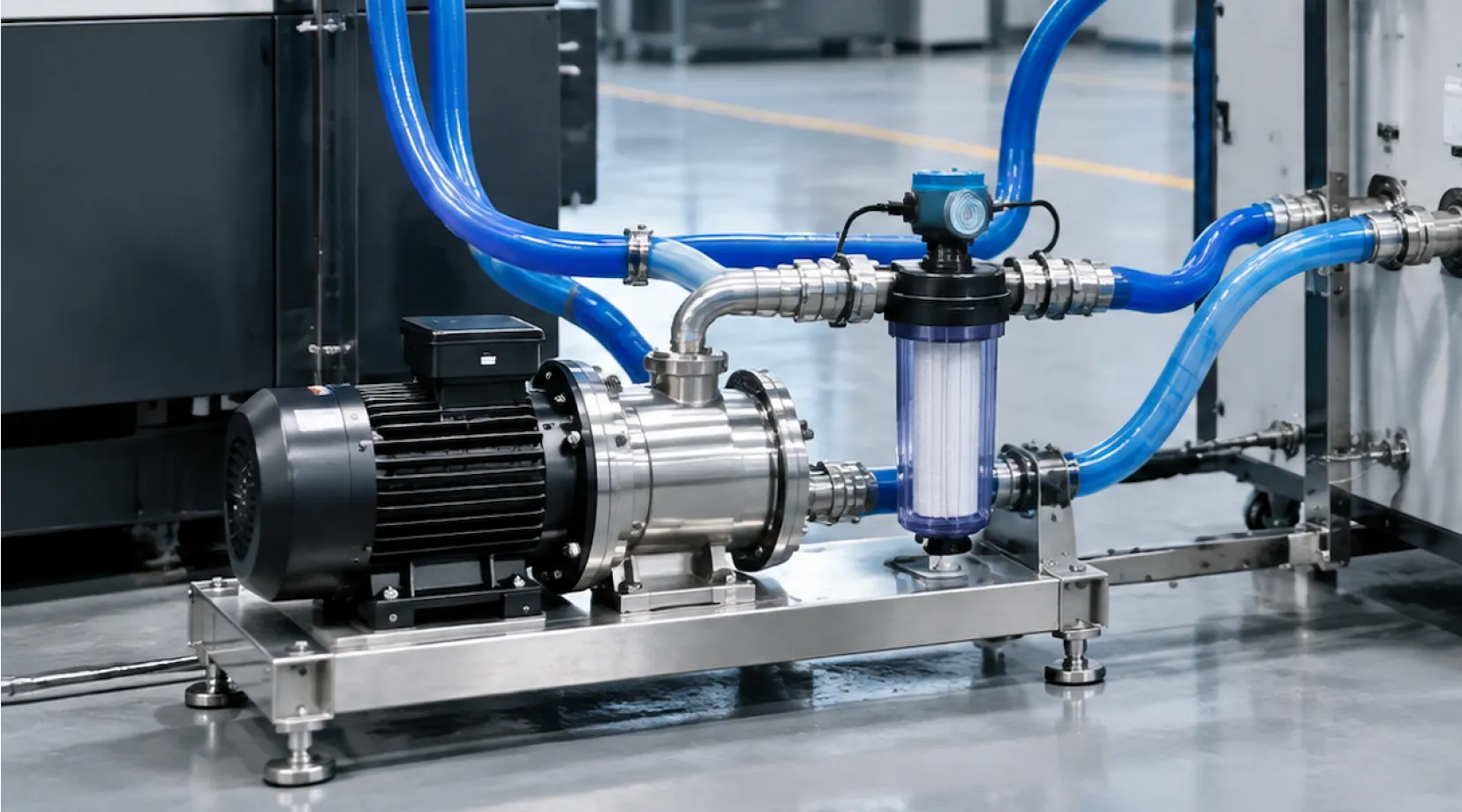
The hydraulic profile of a laser cooling circuit is fundamentally restrictive. Pushing DI water through the dense microchannels of a multi-kilowatt diode array, heavily routed flexible tubing, flow meters, and fine inline particulate filters creates an enormous cumulative pressure drop. A standard 30 kW fiber laser chiller may only require a volumetric flow rate of 30 to 50 Liters Per Minute (LPM), but it must push that fluid against 50 to 80 meters of differential head (5 to 8 bar).
This specific "high-head, low-flow" requirement falls outside the efficiency envelope of standard single-stage centrifugal pumps. If a standard centrifugal pump is sized to meet the pressure requirement, its impeller will be massively oversized for the flow, causing the pump to operate far to the left of its Best Efficiency Point (BEP). Operating a centrifugal pump in this zone causes severe radial thrust, shaft deflection, fluid recirculation, and rapid bearing wear. Alternatively, utilizing a multi-stage centrifugal pump to achieve the pressure adds unacceptable physical length and cost to a compact OEM chiller skid.
The Regenerative Vortex Solution
To resolve this hydraulic mismatch, laser chiller manufacturers specify the vortex pump architecture. Also known as a regenerative peripheral pump, the vortex pump utilizes an impeller with dozens of straight radial vanes machined into its periphery, rotating within a tight-clearance annular channel.
As fluid enters the vortex casing, the spinning vanes accelerate it radially outward. The geometry of the casing forces the fluid to circle back into the root of the vanes, creating a continuous, helical spiral of fluid moving around the periphery of the impeller. The fluid re-enters the impeller vanes multiple times in a single revolution. Each re-entry imparts additional kinetic energy, stacking the pressure sequentially. This regenerative action allows a highly compact, single-stage vortex pump to generate the exact stable high-head performance required to punch through the restrictive microchannels of a laser diode array, while operating perfectly within its designed flow range.
System Integration and Commissioning Rules
Integrating a high-head stainless steel pump into a DI water cooling loop requires strict adherence to system design rules to prevent operational failures.
- Strict Material Whitelists: Every wetted component in the chiller loop—from the pump casing to the pipe fittings, flow sensors, and reservoir tank—must be certified for DI water. Avoid brass, bronze, cast iron, and zinc-plated carbon steel entirely. Utilize 304/316L stainless steel, titanium, PTFE, and high-grade EPDM or FKM elastomers.
- Bypass Valve Integration: Because vortex pumps generate steep pressure curves, shutting off the discharge valve or experiencing a blockage in the laser cooling line will cause system pressure to spike instantly. A mechanical bypass relief valve must be installed across the pump's discharge and suction lines to protect the optical array from over-pressurization.
- NPSHa and Dissolved Oxygen: Deionized water loops are frequently semi-closed systems. To prevent cavitation, the cooling reservoir must be positioned to provide adequate Net Positive Suction Head (NPSHa) to the pump inlet. Furthermore, ensuring the reservoir is sealed with a nitrogen blanket prevents atmospheric oxygen from dissolving into the DI water, which would otherwise accelerate oxidation on any non-passivated metallic surfaces.
Specifying Aulank Pumps for Laser Chiller OEMs
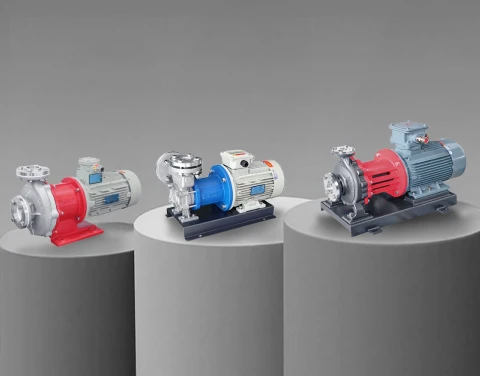
Aulank Pump manufactures dedicated circulation solutions for the optical and precision cooling industries, strictly utilizing passivated stainless steel metallurgy to ensure zero ion leaching. For standard laser chillers, the WH Stainless Steel Vortex Pump delivers robust, high-head regenerative performance in a highly compact footprint, utilizing premium mechanical seals selected specifically for low-particulate wear in ultrapure water.
For ultra-high-end fiber lasers, UV lasers, and semiconductor optical equipment requiring absolute zero contamination, Aulank configures the MDW Stainless Steel Vortex Magnetic Pump. This series combines the high-head hydraulic profile of a regenerative impeller with a sealless magnetic drive architecture. By eliminating the shaft seal entirely, the MDW guarantees zero carbon shedding, zero fluid leakage, and lifetime protection of the critical laser diode microchannels. To optimize the hydraulic selection for your specific chiller platform, contact our engineering team with your flow, head, and fluid conductivity parameters.
