


During the first week of November 2026, the global sulfur and sulfuric acid community gathered in Berlin. CRU's Sulphur + Sulphuric Acid 2026 Expoconference ran from November 3 to 5 at the Estrel Berlin, bringing producers, traders, technology licensors and equipment suppliers together for a dual-streamed technical program and an expanded market outlooks agenda. The timing could hardly have been sharper. Sulfur feedstock entered the fourth quarter at its highest contract levels since 2022, China's by-product acid remained locked out of export markets under a suspension scheduled to run through December, and Northwest European smelter acid had just averaged close to $295 per tonne in September. The conference agenda, from lean-gas catalyst development to wet-gas acid recovery, read like a direct response to the tightest acid market in years. This industry report reviews the supply data behind the squeeze, the trade flows being redrawn around it, and what the November 2026 market means for the equipment that unloads, transfers and circulates sulfuric acid.
The Sulfur Squeeze: How the Market Arrived Here
| Indicator | Value | Timing |
|---|---|---|
| Tampa contract sulfur price | $116 per long ton | Start of 2025 |
| Tampa contract sulfur price | $310 per long ton | Early October 2025 |
| Projected 2026 global sulfur shortfall | Over 5 million tonnes | August 2026 assessment |
| China by-product acid export suspension | Most exports halted | From May 1, 2026 |
| China June 2026 acid exports | -99.2% month on month | June 2026 |
| NW Europe smelter acid, FOB | ~$295 per tonne | September 2026 average |
The feedstock story sets the ceiling for everything downstream. USGS data show Tampa contract sulfur beginning 2025 at $116 per long ton, climbing to $270 by early April, easing to $252 in early July and reaching $310 by early October 2025, the strongest level since the second quarter of 2022. Supply has not kept pace with the demand stack built on top of it: phosphate fertilizer programs in Africa and West Asia, high-pressure acid leach nickel projects feeding battery supply chains, and steady consumption across chemicals and metals. An August 2026 assessment put the projected 2026 global sulfur shortfall at more than 5 million tonnes, a gap that keeps both feedstock and acid prices high and volatile. Because roughly 90 percent of all sulfur is consumed in the form of sulfuric acid, tightness in the yellow solid translates directly into tightness in the world's highest-volume industrial liquid.
China's Export Suspension and the Trade Map It Redrew
The single largest trade shock of the year came from policy. Beginning May 1, 2026, China suspended most exports of by-product sulfuric acid to protect domestic fertilizer production, after Middle East disruptions tightened the upstream sulfur supply available to Chinese acid plants. The effect was immediate: June 2026 exports fell 99.2 percent month on month, and full-year volumes are estimated to finish 60 to 70 percent below 2025, with restrictions currently scheduled through December. The buyers most exposed are Chile and Indonesia, which together absorbed roughly 46 percent of Chinese acid exports in the January to May window. Chile depends on imported acid for heap-leach copper recovery, while Indonesian HPAL operations need it to produce battery-grade nickel sulfate, a dependency chain that connects an acid cargo directly to EV battery economics. Our earlier report on Asia-Pacific chemical capex and the corrosion-resistant pump market tracked the investment side of this build-out; the November market adds the procurement urgency. Inside China, closed export channels have left copper smelters long on by-product acid, compressing domestic prices even as seaborne buyers pay record levels, a divergence that will shape trade flows well into 2027.
What the Berlin Technical Program Signaled
Conference agendas are lagging indicators of where plant money is about to go, and the Berlin program pointed clearly at extraction of more acid from existing assets. Presentations covered a new generation of lower-pass catalysts engineered to raise conversion under lean-gas conditions, with full-scale reference data indicating halved sulfur emissions alongside increased plant capacity. Wet-gas sulfuric acid technology featured prominently as a route to convert refinery and metallurgical off-gases into saleable acid and high-pressure steam, turning an emissions liability into a revenue stream. Metallurgical acid plant operators shared work on inline NOx monitoring and DeNOx measurement campaigns, reflecting the tightening compliance environment around smelter acid production. The common thread across the sessions was debottlenecking: operators facing record acid prices are choosing to squeeze more tonnage from existing contact plants and to monetize gas streams that previously went to scrubbers, and each of those projects carries a fluid-handling scope.
The Fourth-Quarter Price Picture and Buyer Behavior
Spot markets spent the autumn working off record summer levels. Northwest European smelter acid averaged about $295 per tonne FOB in September 2026, down 10.6 percent from August as buyers resisted peak prices and drew on inventories while sulfur costs eased. Forecasts issued in October see the region easing toward roughly $270 per tonne in October and $245 by December, with two caveats that keep desks cautious: seasonal phosphate demand ahead of spring is expected to support prices from late November, and any renewed escalation around the Strait of Hormuz could push values back above $350. For procurement teams, the practical reading is a market that remains historically expensive on any horizon that matters for contract negotiation. Buyers who treated acid as a utility commodity are re-qualifying supply security as a design parameter, which has direct consequences for terminal, storage and transfer infrastructure.
The Equipment Angle: Acid Handling Moves Up the Capital Agenda
Every supply response now on the table involves moving more concentrated acid through more connection points. Import-dependent smelters and HPAL plants are adding berth and tank capacity for seaborne cargoes, and ship unloading at 93 to 98 percent concentration is among the most demanding routine duties in bulk chemical handling. Spent-acid regeneration and recovery projects, which return between 2.5 and 5 million tonnes of acid to service in a typical year, add circulation and transfer duty in hot, contaminated service. Debottlenecked contact plants push circulation rates higher in exactly the service where seal failure consequences are most severe. In each case the specification conversation converges on the same requirements documented in our corrosion-resistant pump solutions for aggressive chemicals and leak-proof pump solutions for hazardous chemicals: wetted materials that hold up across the full concentration range, zero-leakage containment at the shaft, and hardware that tolerates the off-spec batches and temperature excursions that arrive with spot-market cargoes. Projects feeding the battery chain carry the same logic, as covered in our lithium battery manufacturing pump selection guide.
Materials and Configuration Notes for Sulfuric Acid Duty
Sulfuric acid defeats more casual material selections than almost any other common reagent because its corrosivity is a function of concentration and temperature together. Carbon steel stores concentrated acid at ambient temperature successfully, yet fails quickly in dilute service. Common austenitic stainless grades survive only narrow concentration windows. Fluoropolymer linings such as F46 and PFA remain chemically inert across the full range from dilute to 98 percent acid and through the temperature excursions of unloading and circulation duty, which is why lined construction dominates modern transfer specifications. Containment carries equal weight. A mechanical seal weeping concentrated acid is a reportable event with personnel consequences, and the lifecycle arithmetic comparing sealed and sealless configurations is laid out in our analysis of pump total cost of ownership for sealed versus sealless designs. Where the duty includes hot or contaminated acid, or where supply diversification means cargoes of varying strength arrive at the same berth, the case for a lined magnetic drive configuration strengthens further.
Configurations Aulank Supplies for Acid Service
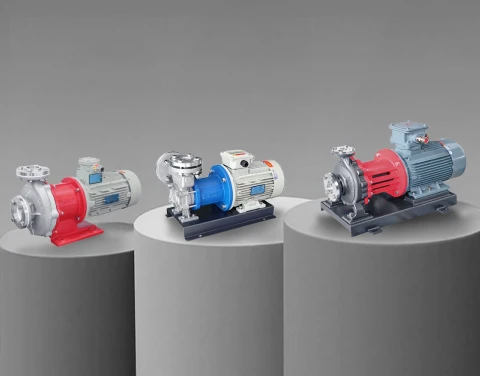
For sulfuric acid unloading, transfer and circulation, the AMC-F fluoropolymer-lined magnetic drive pump is the standard configuration: a one-piece F46 or PFA lined wetted path inert across the full concentration range, pressureless sintered silicon carbide bearings, HG/T2730 standard dimensions, and a sealed containment shell covering flows from 3.6 to 100 m3/h with heads to 80 meters. Where service involves dilute acid blends or mixed waste streams at lower aggressiveness, the AMC(L) chemical process magnetic drive pump in metallic construction extends coverage to 200 m3/h. Both configurations eliminate the dynamic shaft seal, the component whose failure mode dominates acid-service incident statistics.
Send Your Acid Handling Duty for Engineering Review
Acid procurement strategy in this market increasingly includes the equipment that receives it. Whether the project is a new import terminal unloading point, a debottlenecking scope at an existing contact plant, or a transfer upgrade ahead of contract renegotiation, the selection rests on the same inputs: concentration range across all credible cargoes, temperature profile including upset cases, duty points for each transfer service, and the site's containment requirements. Send your concentration, temperature and operating points through the contact page, and the engineering team will return a prepared selection with curves, material confirmation and installation notes.
