




Every facility manager facing AI hardware in a legacy hall runs into the same dilemma: the racks arriving need 30, 40, 60 kW of cooling, and the room was engineered for a tenth of that. Rebuilding the cooling plant means construction cost, downtime risk, and a building redesign nobody budgeted for. The rear-door heat exchanger exists precisely for this situation. It replaces the standard rear door of a server cabinet with a liquid-cooled coil that captures heat at the rack exit, leaving the servers, the room layout, and most of the existing infrastructure untouched. Market research tracks 83 percent of new data center projects now planning RDHx deployment, and brownfield operators have made it the default bridge between air cooling and full liquid cooling. This guide explains what an RDHx is, how active and passive types differ, why the economics favor it in retrofit projects, and what the liquid loop behind the door demands from its circulation equipment.
What a Rear-Door Heat Exchanger Is and How It Works
An RDHx is best pictured as a radiator hung where the rack's rear door used to be. Servers exhaust air at 50 to 60°C straight into the door's finned coil. Chilled or tempered water, typically supplied at 14 to 18°C, circulates through the coil and absorbs the heat, so air leaves the rack at near room temperature and the data hall never sees the heat load. The warmed water, returning at 20 to 30°C, travels back to the chiller plant or a coolant distribution unit to be cooled again. Because the exchange happens within centimeters of the heat source, sensible heat capture reaches 90 to 100 percent, and optimized installations report PUE values down to 1.1. A modulating valve adjusts water flow against return temperature, so the door follows the rack load in real time, and monitoring feeds status into the DCIM or BMS like any other managed device.
Active vs Passive: The Fan Question
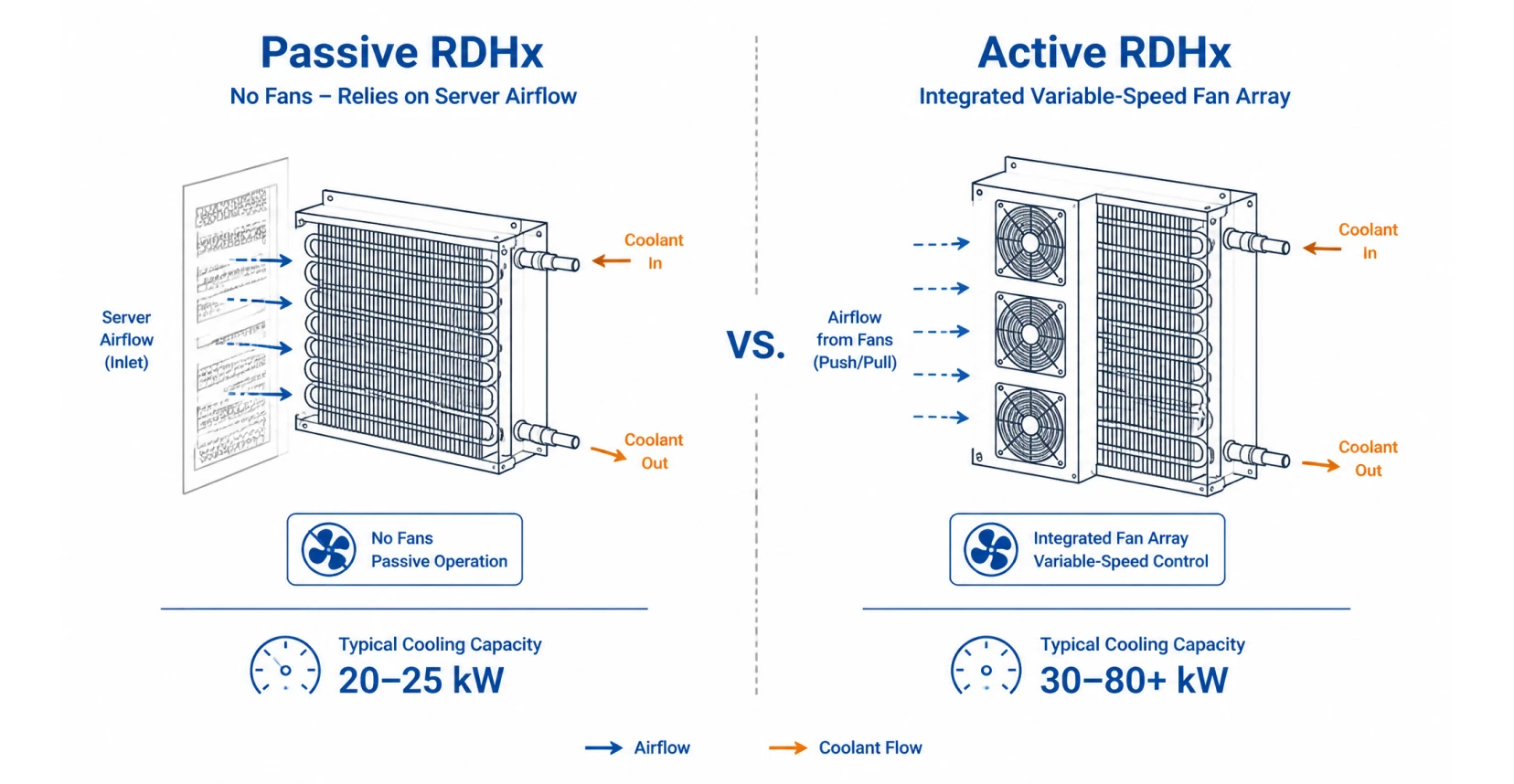
| Criterion | Passive RDHx | Active RDHx |
|---|---|---|
| Airflow source | Server internal fans only | Integrated variable-speed EC fans |
| Typical capacity | Up to 20 to 25 kW per rack | 30 to 80+ kW per rack; leading units past 100 kW |
| Auxiliary power | None | 200 to 800 W per rack for the fan array |
| Unit cost | Baseline | 25 to 40 percent above passive |
| Control | Follows server airflow | Independent airflow control, BMS integration, hotspot response |
| Best fit | Moderate density, energy-first projects, edge sites | AI and HPC racks, fluctuating loads, high-density zones |
The capacity difference comes from physics: a passive door is limited by what server fans can push through the coil's pressure drop, while an active door's fans generate their own airflow. A 20 kW rack at a 10°C air temperature rise needs about 3,500 CFM, typically spread across four to six large axial fans operating below full speed with N+1 redundancy. Market data shows active units displacing passive as the new-build default, with the 60 to 80 kW tier growing fastest, while passive retains the moderate-density and retrofit-without-power-upgrade niches.
Why the Economics Favor the Door in Retrofits
The retrofit case rests on five compounding effects. First, capturing heat at the source lets operators raise room ambient temperature and stop overcooling the whole hall for its hottest rack. Second, RDHx coils work with warmer supply water than chilled-air systems, which lifts chiller efficiency and stretches free-cooling hours across the year. Third, retiring or downscaling CRAC and CRAH units recovers white space, which is revenue for colocation operators and deferred construction for enterprises. Fourth, deployment proceeds rack by rack in a live facility, validating performance before expanding, with no hall-wide shutdown. Fifth, a cooling fault stays local to one rack instead of propagating across a shared air system. An ASME-modeled comparison quantified the pattern: substituting RDHx for perimeter CRAH units flattened room temperature distribution and cut CRAH energy use measurably even at partial load, where conventional plant runs least efficiently.
Where the Door Sits on the Cooling Ladder
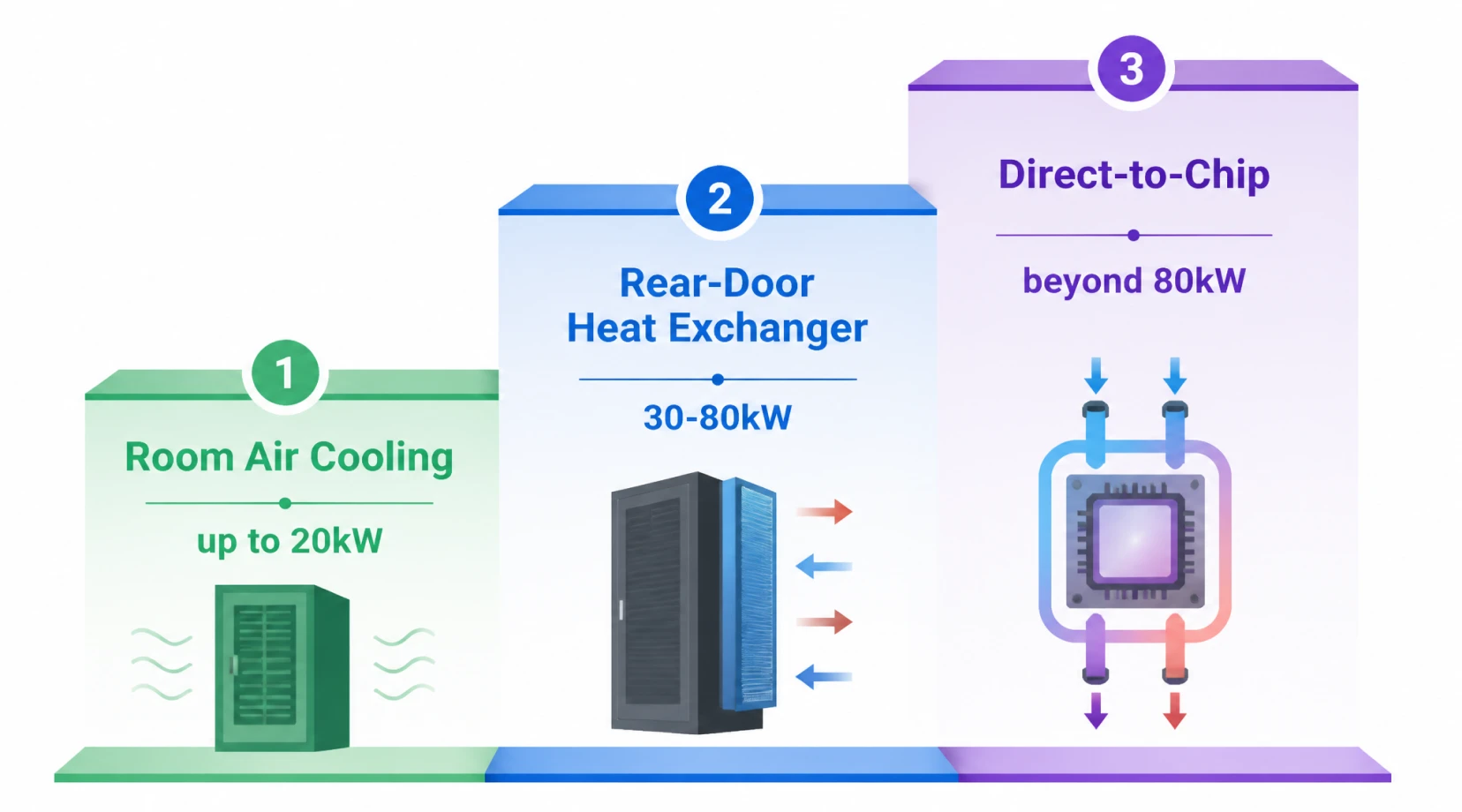
RDHx occupies the middle of a three-step migration. Room air cooling covers legacy densities up to about 20 kW. The door takes over the 30 to 80 kW sweet spot that current AI expansion actually occupies, and it does so without touching the servers. Direct-to-chip cold plates claim the territory beyond, once hardware refresh cycles bring liquid-cooled platforms into the estate. Hybrid arrangements already operate in production: doors handle the bulk rack load while a direct-to-chip loop serves the accelerator trays inside the same cabinet. The strategic value is organizational as much as thermal: running water-based cooling in the white space builds the operational skills, water treatment habits, and vendor relationships that full liquid cooling will later require. For the physics of why each step on this ladder exists, see why air cooling hits a wall; for the unit that manages the liquid loops behind the doors, see what a coolant distribution unit is.
What the Door Does Not Solve
Honest evaluation starts with the limits. The servers inside the rack remain air-cooled: their internal fans still move heat from silicon to exhaust air, consuming server power and producing the noise the door cannot remove, and component temperatures inside the chassis stay on air-cooling physics. The door captures heat after it leaves the server, which protects the room yet leaves the server itself exactly as hot as before, so the highest-flux accelerators still demand cold plates. Doors also add weight and depth at the rack rear, complicating cable management and aisle clearance, and water-filled coils introduce a fluid circuit into spaces designed around air, with the treatment and monitoring program that implies. None of these argue against deployment; they define the boundary where the ladder's next step begins, and facilities that understand the boundary plan the transition instead of discovering it.
The Hydraulic Side: What the Loop Behind the Door Demands
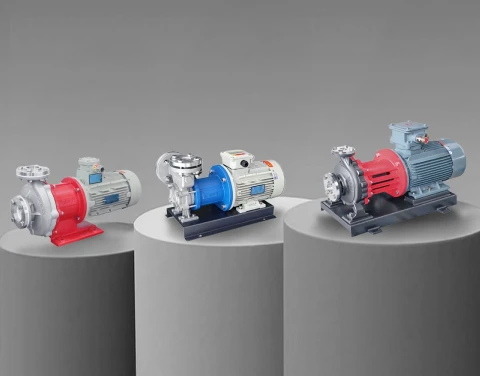
Every RDHx is a water loop endpoint, and the loop decides how well the door performs. Deployments take one of two shapes: open-loop connections into an existing chilled water system where building plant capacity allows, or closed-loop architectures where a liquid-to-liquid CDU isolates a dedicated coolant circuit for a rack or a row. The closed-loop pattern dominates new installations because it decouples door hydraulics from building systems and holds supply temperature above dew point under active control. Either way, circulation equipment carries specific duties: continuous 24/7 operation, variable flow against the modulating valves, clean-water or glycol chemistry discipline, and leak integrity above live electrical equipment. Seal-less magnetic drive circulation pumps answer the leak requirement by construction, eliminating the shaft seal whose failure would drip coolant into a rack; the MDW series covers this duty with stable low-flow pressure, and the selection framework appears in the AI data center liquid cooling pump selection guide. Leak risk planning extends beyond pumps to dripless quick disconnects, routed piping, and rack-level leak detection, because operators consistently rank coolant escape as the top concern in white-space water cooling.
Deployment Checklist
- Rack load profile: current and planned density per rack, which selects passive or active and sizes the coil.
- Water supply: available chilled or tempered water temperature, and whether existing plant capacity supports open-loop connection or a CDU is required.
- Hydraulics: loop flow and pressure drop budget across doors, manifolds, valves, and the CDU heat exchanger.
- Structural: door weight and swing, rack compatibility, and floor loading with water-filled coils.
- Operations: water treatment program, leak detection points, and maintenance access behind the racks.
- Migration path: how the door installation pre-positions piping and skills for the later direct-to-chip phase.
Aulank Pump manufactures seal-less magnetic drive circulation pumps for RDHx loops, CDUs, and data center liquid cooling duty, with zero-leakage containment and media ratings from −196°C to +400°C. Send us your loop flow and pressure data, and our engineering team will return a matched pump with the sizing calculation. Contact us for support on your retrofit or new-build project.